
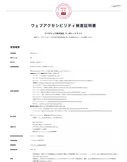
Web Accessibility Inspection Certificate
We issue an inspection certificate for the accessibility inspection performed, including the scope covered, evaluation criteria, and inspection details.
View sample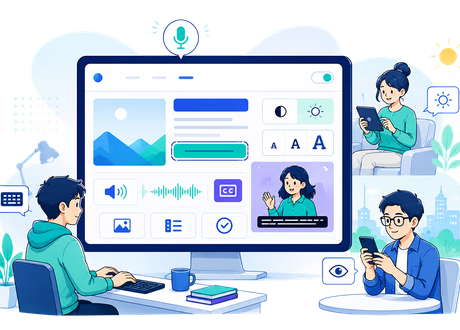
Drawing on our experience in design and frontend implementation, we clearly explain not only what problems we find but also how to fix them. We check real usability with keyboards and screen readers, and work with you to identify improvements your production team can act on.


Chief Accessibility Officer (CAO), Liberogic Inc.
IAAP Certified Web Accessibility Specialist (WAS)
Note: Liberogic Inc. is an organizational member of the International Association of Accessibility Professionals (IAAP).
In Liberogic's manual audits, our experts use keyboards and screen readers to navigate your pages directly and check items such as the following.
We organize each issue we find with its location, the applicable success criterion, and direction for improvement, and manage the process from fixes through re-verification in Lente Audit below.
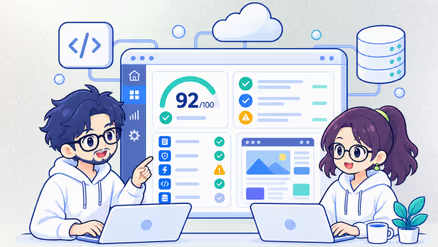
In a dedicated workspace, where you can see audit status
When you request an audit, we set up a dedicated workspace for you in Lente Audit. You can check progress in the same place both while the audit is underway and after it is complete.
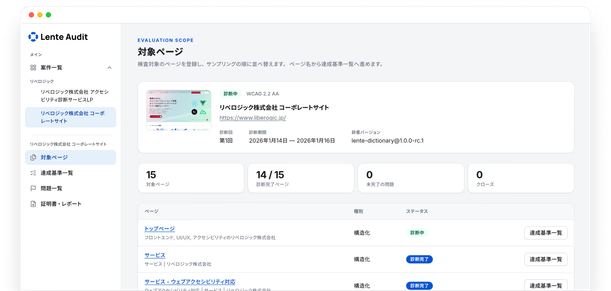
Check audit progress and the status of each page in real time. You can start addressing issues as they are found, without waiting for the final report.
Issues are organized and reported by diagnosis result, suggested improvement, and location. You can share fix status with the diagnostician and ask questions or report fixes through comments. There is no need to exchange files back and forth by email.
You can download issued certificates and reports from your workspace at any time. When a re-diagnosis updates the verdict, a new version will be issued.
Saying that accessibility work has been "completed" does not allow third parties to verify its content or scope. At Liberogic, we organize inspection results into documents tailored to the purpose of the diagnosis or the recipient. Documents can be issued in either Japanese or English.
We issue an inspection certificate for the accessibility inspection performed, including the scope covered, evaluation criteria, and inspection details.
View sample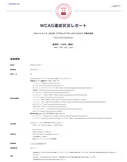
This report organizes evaluation results for each WCAG success criterion on a per-page basis, so you can see which criteria are met and where issues remain.
View sample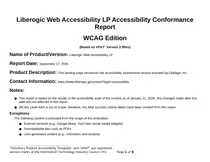
We create an ACR (Accessibility Conformance Report) based on the VPAT® used in transactions with overseas companies and in procurement of ICT products and services. We support the WCAG edition as well as the U.S. Section 508 edition, the EU (EN 301 549) edition, and the International (INT) edition.
We can also consult with you about web applications and web services, not just websites.
View samplePricing is determined by the number of target pages (screens) and the complexity of each screen.
Pricing Guide
Approximately 10 pages for a corporate site: JPY 300,000 and up (excl. tax)
If you would like to check your current status for free first, try our in-house automated audit tool, Lente Scan.

We review the target websites or services, the purpose of your accessibility efforts, and your preferred standards and timeline.

We review the site's page structure and features, then determine which pages and screens to audit and which evaluation criteria to apply.

We conduct manual audits led by experts, focusing primarily on WCAG 2.2 Level A and AA success criteria.
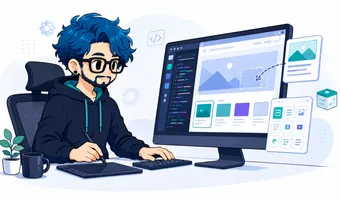
For each issue identified, we provide specific, actionable remediation guidance.
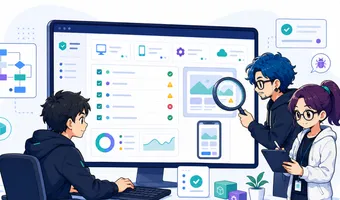
We review the revised pages to verify that the applicable success criteria are met.

We consolidate audit findings and issue a web accessibility audit certificate and a compliance status report. We also support the development of your accessibility policy.
Finding issues in an accessibility audit doesn't lead to real improvement unless you know how to fix them.
Liberogic is a production and development company that routinely handles the design and frontend development of websites and web applications.
Based on the diagnostic results, we propose practical improvements that can be implemented, taking into account the impact on your existing design and systems.
Beyond providing fix recommendations, we offer end-to-end support, including implementation by Liberogic and re-diagnosis after the fixes are made.
We properly implement headings, landmarks, links, and forms with semantic HTML, improving the structure so that it is easier to understand for assistive technologies such as screen readers.

We check contrast for text and UI components based on WCAG success criteria.
We improve UI to be easier to see and understand, including information design that does not rely solely on color.

We check and improve focus order, focus visibility, and keyboard operation so that key features can be used without a mouse.

We implement alt text, labels, status notifications, WAI-ARIA, and other elements appropriately, so that information and actions are conveyed accurately to users of assistive technologies.

We also review interactive UI elements such as input forms, error messages, modals, tabs, and accordions.
We go beyond visual design, implementing and verifying that everything can be operated by keyboard and assistive technologies.

In web accessibility, it is important not only that users can operate a site, but also that the information itself is easy to understand.
We support the creation of content that reaches a wider range of users, with attention to sentence length, wording, and technical terminology.

The standards and evaluation methods surrounding web accessibility are continuously updated in line with changes in the web and digital services.
The current JIS X 8341-3:2016 is based on ISO/IEC 40500:2012, an international standard with the same content as WCAG 2.0.
Since then, the W3C has updated the guidelines to WCAG 2.1 and WCAG 2.2. In September 2025, ISO/IEC 40500 was also revised and now has the same content as WCAG 2.2.
In response, Japan is moving forward with a revision of JIS X 8341-3 so that it aligns with ISO/IEC 40500:2025.
Liberogic goes beyond meeting the current JIS requirements. We conduct audits and improvements based on WCAG 2.2 Levels A and AA.
Websites and web services aimed at overseas audiences may be subject to accessibility requirements beyond WCAG, such as Section 508 in the United States and EN 301 549 in Europe, depending on the region and procurement conditions.
In transactions with overseas companies and ICT procurement, you may be asked to submit a VPAT / ACR that documents your accessibility conformance.
The W3C is also developing "WCAG 3.0," the next generation of the WCAG 2.x series.
WCAG 3.0 is not a simple update to WCAG 2.x. It is being considered as a new set of guidelines that includes new evaluation methods and conformance concepts.
It is still under development, but it is designed to cover a broader range of digital environments, including web applications and mobile.
Liberogic bases its accessibility work on the current WCAG 2.2 standard, while also continuously monitoring overseas accessibility requirements and future standardization developments, including WCAG 3.0.
Beyond our diagnostic services, we also develop and publish in-house tools that help teams check accessibility during web production and ongoing operations.
Lente Scan is an automated web accessibility checking tool that combines axe-core with our proprietary diagnostic engine, Lente Detect.
It identifies issues that can be detected automatically, and also displays items that cannot be judged by automation alone and require human review.
Free to use, no registration required.
Liberogic offers free Chrome extensions developed from real-world web production and accessibility diagnostic work.
Chrome Extension
Select the area of the web page you want to check, and verify the contrast between the foreground and background colors based on the pixels actually displayed.
It can also be used for images, gradients, and other expressions that are difficult to evaluate from CSS values alone.
Chrome Extension
Select an area of interest and wait a few seconds. The tool analyzes the number of flashes and the affected area from the actual rendering and evaluates them against WCAG's flash thresholds (2.3.1 and 2.3.2).
Check what's moving on the page right on the spot.
Chrome Extension
Organizes the structure of the web page in the side panel, including headings, links, landmarks, and ARIA.
Review accessibility issues while getting an overview of the entire page structure.
Chrome Extension
Assesses the readability of web text based on difficult vocabulary, long sentences, and the proportion of kanji.
Supports improvements to make Japanese text easier to understand.

Have you run into any challenges with web accessibility compliance?


