

Hello, this is Oga from Liberogic.
We have recently earned the "Trusted Tester for Web" accessibility testing certification from the U.S. Department of Homeland Security (DHS)!
It all started with a consultation from a client.
They needed accessibility testing compliant with Section 508 for a U.S. federal government procurement project, which led us to think, "Oh, we might actually need this certification!"
This time, we decided to take on the challenge together with Mr. Futamata, a WAS (Web Accessibility Specialist) holder within the company.
Mr. Morimoto was also eager to get certified, but unfortunately got caught up in the infamous PHP incident and had to drop out midway.
He's now saying things like, "Then maybe I'll go for CPACC or ADS instead."
...I wonder if he'll really get it.
WAS is a web accessibility specialist certification accredited by the IAAP.
Studying alongside Mr. Futamata gave me the chance to explore a somewhat different way of thinking from the WCAG-based testing we usually do.
So, what exactly is a Trusted Tester?
The Trusted Tester is a web accessibility testing certification program offered by the U.S. Department of Homeland Security (DHS).
U.S. federal agencies are subject to the legal accessibility requirements of Section 508, and the Trusted Tester program is designed to verify conformance with those requirements through a defined testing procedure.
At Liberogic, we normally perform WCAG-based testing and remediation, but for this project we also needed an understanding of U.S. regulations and testing methods.
By the way, the Trusted Tester certification is not required for all U.S. federal government procurement projects.
The testing methods and requirements vary by project.
I'll leave the details of how to get certified to those who know more about it!
Trusted Tester is a certification that you can study for and take online.
The passing score for the certification exam is 85% or higher.
The training program has a completion deadline of 180 days.
That said, you don't have to study for 180 days straight.
According to the official guidance from before, the estimated study time for first-time candidates was about 40 to 80 hours. I think people who already work as testers on a regular basis can pass without much trouble.
Several people have already written detailed Japanese-language guides on study methods and exam preparation.
Reference articles: DHS Trusted Tester Certification memo, "[Web a11y] My DHS Trusted Tester Certification exam experience"
Here, I'll mainly share what I felt after actually taking on the challenge.
I thought knowing WCAG would make it a breeze... but it wasn't!
What I found particularly interesting this time was this point.
Trusted Tester is not unrelated to WCAG.
Section 508 incorporates the success criteria for WCAG 2.0 Levels A and AA.
Since we regularly work with WCAG, it wasn't an entirely unfamiliar world for us, but as we progressed through the study material, we found that things were quite different from what we expected.
It differs from WCAG 2.2 in terms of the success criteria it covers
First, the WCAG 2.2 that is commonly used today and the WCAG 2.0 that Section 508 references differ in their applicable success criteria.
For example, the success criteria added in WCAG 2.2, such as "Focus Not Obscured (Minimum)" and "Target Size (Minimum)", are not included in WCAG 2.0, which Section 508 directly references.
So knowing the newer WCAG doesn't mean you can simply apply that knowledge as-is.
Not only "whether there is a problem" but also "how to judge it"
Another major difference is in how the testing is carried out.
In typical accessibility testing, you understand the WCAG success criteria and evaluate issues while considering various technologies and usage conditions. In contrast, with the Trusted Tester, you make judgments by following a predefined testing procedure.
"This isn't great for accessibility, is it?"
Even if you think this, with the Trusted Tester you need to follow the procedure to confirm whether the test condition applies and how the result should be recorded.
For example, if the item under test does not exist, you may determine it as "Does Not Apply."
In other words, there are situations where you must not rely solely on your everyday experience and knowledge to make a judgment.
Understanding accessibility and being able to correctly apply a specified testing procedure are quite different things.
This was a particularly educational part.
And the result of the match against the WAS holder is...
Now, back to the main point.
Mr. Futamata, who took on this challenge with me, holds the IAAP WAS certification.
He is also my accessibility mentor, leading the development of Liberogic's accessibility guidelines and accessibility-related applications, so naturally his knowledge and experience in accessibility far exceed mine.
This was the Trusted Tester exam I took alongside Mr. Futamata.
We both passed on the first attempt!
And when I compared our total scores...
I won!
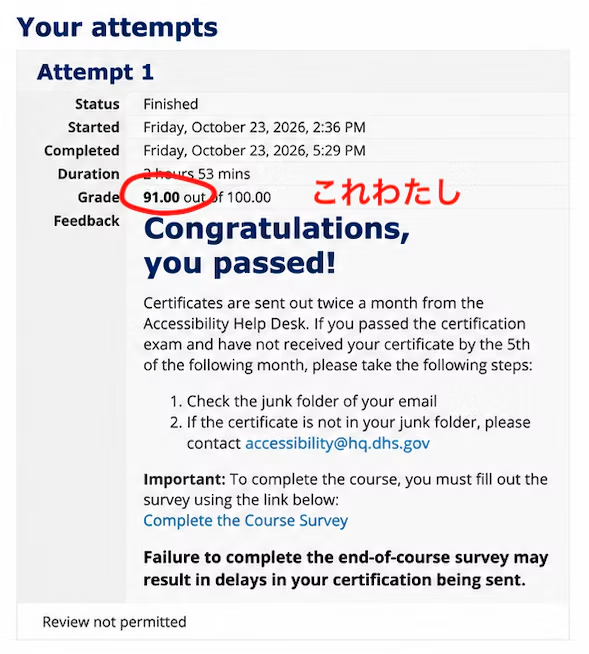
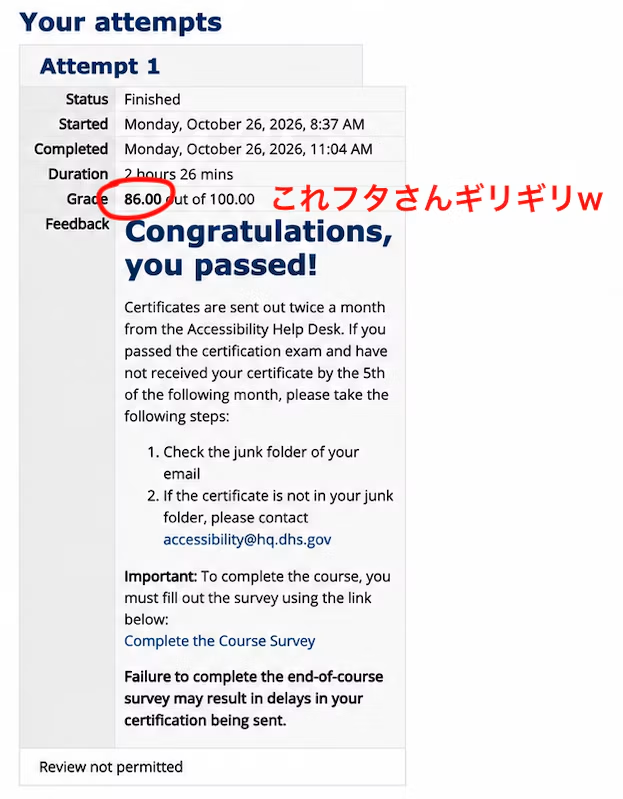
I outscored a WAS holder!
...I'm a little pleased, so please let me brag about this.
Of course, this refers only to the Trusted Tester exam we took this time.
WAS is a certification that broadly tests specialized knowledge of web accessibility, while Trusted Tester requires the ability to accurately apply the testing procedures based on Section 508.
Since the certifications have different purposes, scores alone do not determine superiority. However, because we challenged them at the same time, it was an interesting experience to see how our thinking and judgment differed.
And most of all, I'm glad we both passed on the first attempt!
Earning a certification isn't the goal, after all.
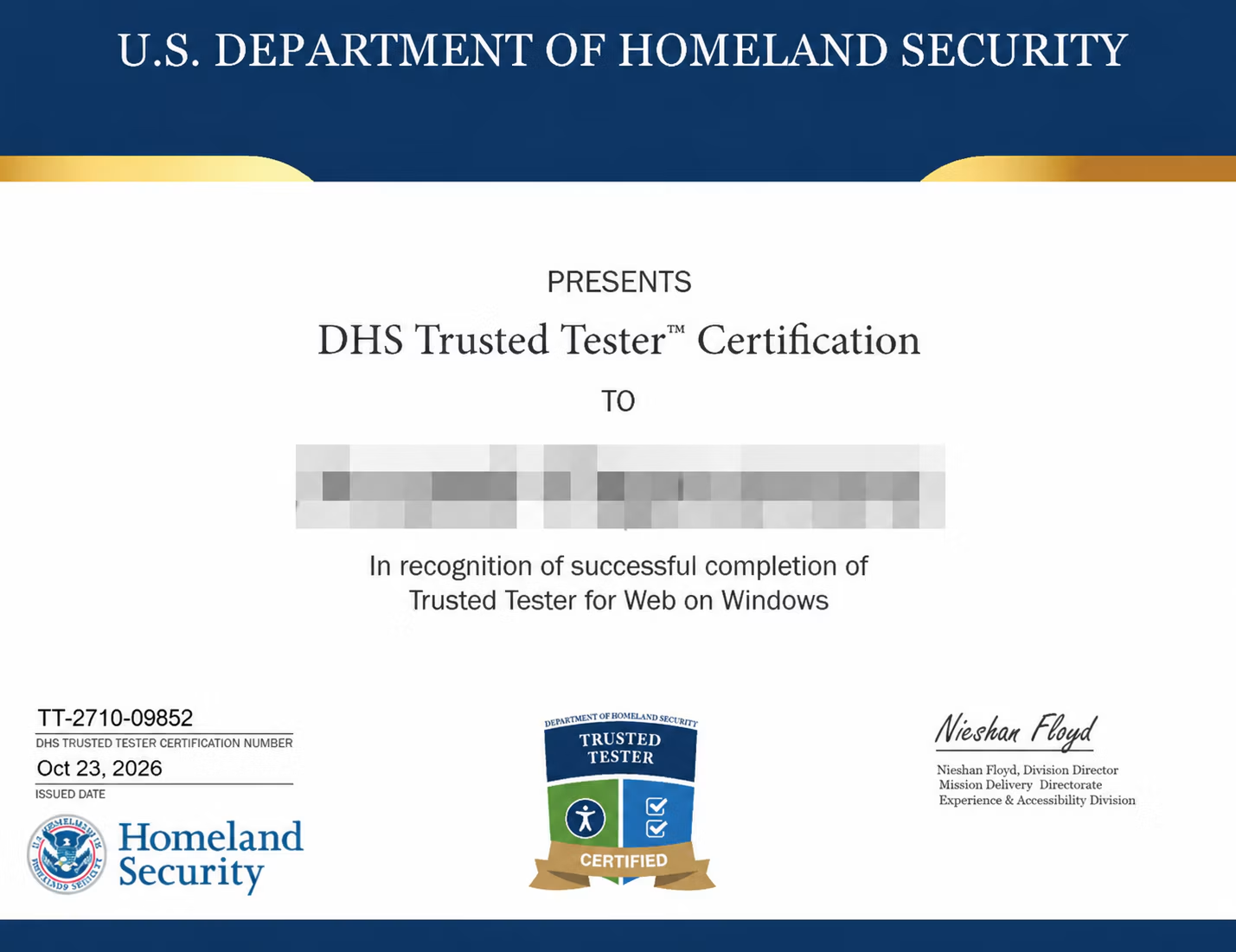
This time, our Trusted Tester certification came about at the request of a client, and it gave us the chance to look at accessibility testing from a perspective different from our usual audits.
At Liberogic, we handle a wide range of accessibility projects, not only for websites in Japan but also for overseas e-commerce sites and complex web applications.
We also plan to put the Section 508 knowledge and Trusted Tester testing methods we learned this time to good use in future projects.
Taking on this challenge alongside a WAS holder was truly a worthwhile experience.
So, what should we take on next, Futamata-san!
Of course, we're counting on you for future work too!


Based in Fukushima, I spend my days in constant negotiations with my highly energetic son. Drawing on my art school background, I work as a designer, accessibility tester, and operations manager all at once. Years of parenting have sharpened my adaptability and quick thinking, which are my greatest strengths.
Oga
Designer / Accessibility Tester / Operations Manager