
Unified Security and Operations While Preserving Diverse Site Architectures
We rebuilt the infrastructure for 10+ websites operated by Kashiwabara Corporation and its group companies, using Cloudflare as a common platform foundation.
Within the group, multiple websites exist with different purposes and operational structures: corporate sites, brand sites, recruitment sites, and campaign sites.
Rather than replacing all sites with uniform technology, this project consolidated DNS, security, delivery, and monitoring functions into Cloudflare while preserving each site's architecture and operational approach.
For major corporate and brand sites, we refreshed the frontend using Astro and microCMS. This approach strengthens governance across the group while enabling flexible operations tailored to each site.
Project Background
With business expansion and branding initiatives, the group's number of websites and content volume—including videos and images—continued to grow.
However, each site was built at different times with different technologies and operational structures, creating challenges.
- Server and DNS management varies by site.
- Security practices and maintenance methods differ across sites.
- Display performance has declined due to increased high-resolution video and image content.
- Multiple stakeholders, including external vendors, operate separate environments.
- Ongoing maintenance costs are incurred for OS and middleware updates, failure monitoring, and more.
- It is difficult to oversee all group websites holistically.
Simply migrating servers alone cannot resolve these challenges.
To address this, we rebuilt the web infrastructure for more than 10 public websites operated by Kashiwabara Corporation and its group companies, using Cloudflare as a common foundation.
Migration strategy without enforcing uniform configuration
Consolidating group sites by migrating all of them to the same CMS or framework can significantly disrupt existing operational workflows and external vendor partnerships.
In this project, we organized each site's role, update frequency, operational responsibility, and future renovation plans, then selected the migration method best suited to each.
Overall migration design flow
- Investigate the configuration, DNS, servers, CMS, and operational structure of each group site
- Organize each site's role and update method, and identify related vendors
- Classify which sites will be modernized and which will maintain their existing configuration
- Refresh major sites with an Astro × microCMS configuration
- Sites continuing with the existing CMS will have their environment isolated from the major sites
- Consolidate DNS and communication paths for all sites on Cloudflare
- Integrate security settings and monitoring methods into a group-wide policy
- Transition incrementally and move to the operational and monitoring structure for post-launch
We respect each site's specific needs while establishing a common foundation through Cloudflare, balancing flexibility and governance.
.png?fm=avif)
Building a common foundation with Cloudflare
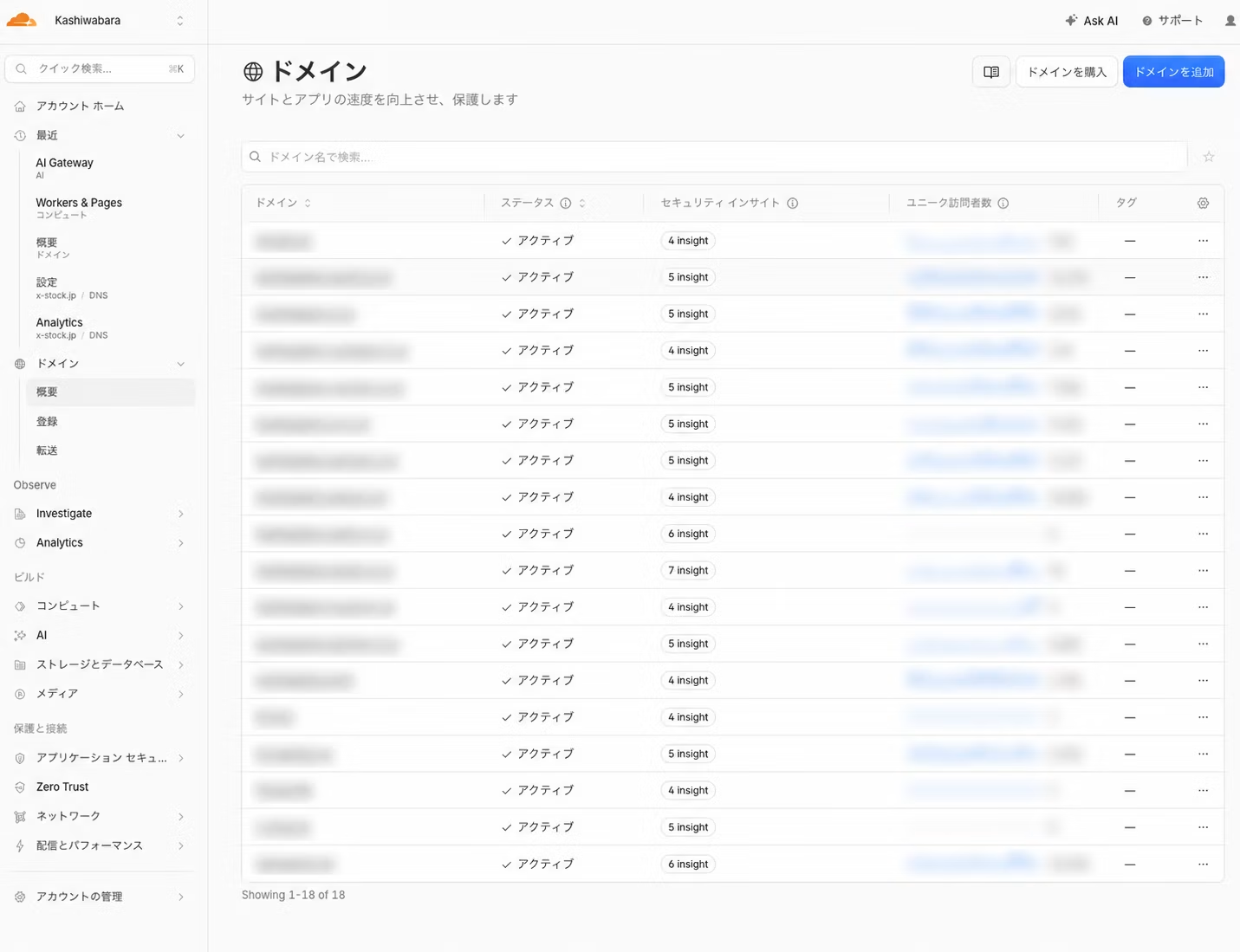
We consolidated DNS and network routes for over 10 websites to Cloudflare.
Even when each site uses different servers or CMS platforms, by centralizing the internet connection point at Cloudflare, we've created a structure that makes it easy to apply consistent security and delivery policies across the entire group.
Centralized DNS management
We consolidated DNS management, previously distributed across multiple sites, into Cloudflare.
We now have visibility across all domain configurations and have built an operational foundation that makes it easier to handle site additions, migrations, and configuration changes.
Content delivery through CDN
By delivering static files—images, video, CSS, JavaScript, and more—through Cloudflare's network, we reduce the load on origin servers.
Even for sites heavy with rich content, we've built a delivery foundation that supports stable performance.
Unified security policy
We positioned Cloudflare in front of each site, enabling a configuration that leverages security features such as WAF and DDoS protection.
Rather than relying solely on individual servers, we control traffic through a shared entry point across the group, making it easier to standardize security measures that previously differed by site.
Building shared components with Astro × microCMS and deploying across multiple sites
For major corporate and brand sites, we adopted Astro and microCMS to modernize our frontend implementation and content management foundation.
Rather than building each site's environment from scratch, we organized shared implementations and configurations that can be used across multiple sites, and built common components based on Astro. Each site then leverages these shared components while implementing design, content, and necessary features individually.
This approach allows us to maintain each site's brand and operational policy while keeping quality, maintainability, and development efficiency consistent across the entire group of sites.
Standardizing while preserving individuality by site
We standardized only the technical foundation rather than unifying all sites under the same design and features.
Since design, content structure, and required features for each site can be designed individually, we can leverage the benefits of a shared foundation without compromising brand expression or operational methods for each organization.
Frontend that moves only where needed
With Astro's island architecture, JavaScript runs only in areas that require interactive functionality.
By avoiding uniform JavaScript loading across the entire page, we've achieved both rich expression through video and high-quality images, and lightweight web pages.
Content management with microCMS
For content management, we adopted microCMS, a headless CMS solution.
By separating the frontend that handles display from the CMS that manages information, we can flexibly design each site's appearance and functionality while enabling team members to update content routinely.
A foundation for sustainable development and maintenance
By leveraging shared packages, we've prevented inconsistent implementations and configurations from accumulating across different sites.
We've made it easier to build new sites, add features to existing ones, and update shared components, creating a development foundation that supports long-term operation of multiple group sites.
Additionally, by adopting a static-delivery-focused architecture, we've reduced the operational burden of OS and middleware management that was traditionally necessary. This allows the team to focus resources on content operations and site improvements rather than maintenance work alone.
Related article
https://www.liberogic.jp/topics/20250804-AstroComponent/
Environment separation to leverage existing CMS
For recruitment sites, campaign sites, and other projects that prioritize external vendor integration or rapid updates, we continue to use existing CMS platforms such as WordPress and Movable Type.
However, rather than mixing them within the same environment as our primary sites, we have separated the servers and operational infrastructure.
This architecture limits the scope of impact should any CMS or server encounter an issue.
We strengthen risk management across the entire group without significantly changing existing production and operational workflows.
Connect different site configurations with Cloudflare
The primary sites and existing CMS sites operate independently in separate environments.
At the same time, we manage DNS, communications, security, and monitoring under a unified policy centered on Cloudflare.
This approach maintains technology and operational structures tailored to each site while establishing a centrally governed web infrastructure across the entire group.
.png?fm=avif)
Changes after implementation
Item | Before migration | After migration |
|---|---|---|
Infrastructure management | Management endpoints and configurations scattered across each site | Consolidated to a shared platform centered on Cloudflare |
DNS management | Individual management by domain | Managed across group sites |
Frontend | Architecture dependent on server or CMS | Refreshed main site with Astro × microCMS |
Content delivery | Delivery centered on origin server | Leveraging Cloudflare's network |
Security | Individual handling per site | Architecture that makes it easy to apply common policies |
Integration with external vendors | Mixed different environments | Isolate your existing CMS as an independent environment |
Maintenance and monitoring | Server-level maintenance and management | Transition to cross-site monitoring |
Continuous improvement | Easier resource allocation for maintenance | An environment where you can focus on content operations and improvements |
Integration, not standardization, across multiple sites
In this project, rather than replacing all 10+ websites with a single technology stack, we maintained configurations suited to each site's purpose and operational requirements.
At the same time, we unified DNS, communications, security, and monitoring across the group by using Cloudflare as a shared foundation.
The main site was modernized with Astro × microCMS, while sites continuing with existing CMS systems were isolated into independent environments, balancing performance, operational efficiency, and security.
Rather than forcing different sites to conform uniformly, the key to this web platform renewal was establishing a management structure that leverages each site's unique characteristics while maintaining overall cohesion.
A project made possible through team understanding and collaboration
This project, which involved migrating over 10 websites to a shared platform while maintaining ongoing operations at each site, was exceptionally challenging—not only technologically, but also in coordinating across all stakeholders.
We were able to assess the distinct objectives, operational structures, and existing workflows for each site and transition to a future-ready platform thanks to the deep understanding and forward-thinking support of everyone at the KASHIWABARA Group, who embraced change and drove the project forward.
We also received tremendous support from Nippon Design Center Inc., who handled branding and creative work, Original Text Inc., who supported overall project management and structure, and all partner companies involved in the creation and ongoing operation of each site.
Members from different backgrounds and expertise areas came together, pooled their knowledge, respected existing systems, and aligned toward the shared goal of a better web platform—this collaborative spirit was the driving force that brought the project to completion.