
Hello, this is Morimoto from Liberogic.
This is a retrospective on a multilingual SEO experiment we conducted on our own site starting in autumn 2025. When we generated a large volume of pages all at once, we initially thought "Google taught us a lesson!" in response to dramatic changes in search metrics. However, various causes and hypotheses were mixed together, so I'm documenting this as a past case for reference.
1. Suddenly expanding to multiple languages
Based on our Japanese content, we deployed to eight languages using Google Cloud Translation API's neural machine translation: English, French, Spanish, German, Dutch, Simplified Chinese, and Traditional Chinese, plus the original Japanese.
Don't worry, there's nothing forbidden! I've prepared thoroughly after reading your article.
I'm generating static pages with Astro, setting canonical tags and hreflang perfectly, and clearly stating that I'm using machine translation.
I've reviewed Google's spam policy, and checked out John Mueller's interview video too! I came in fully prepared.
Technically, I put considerable effort into this.
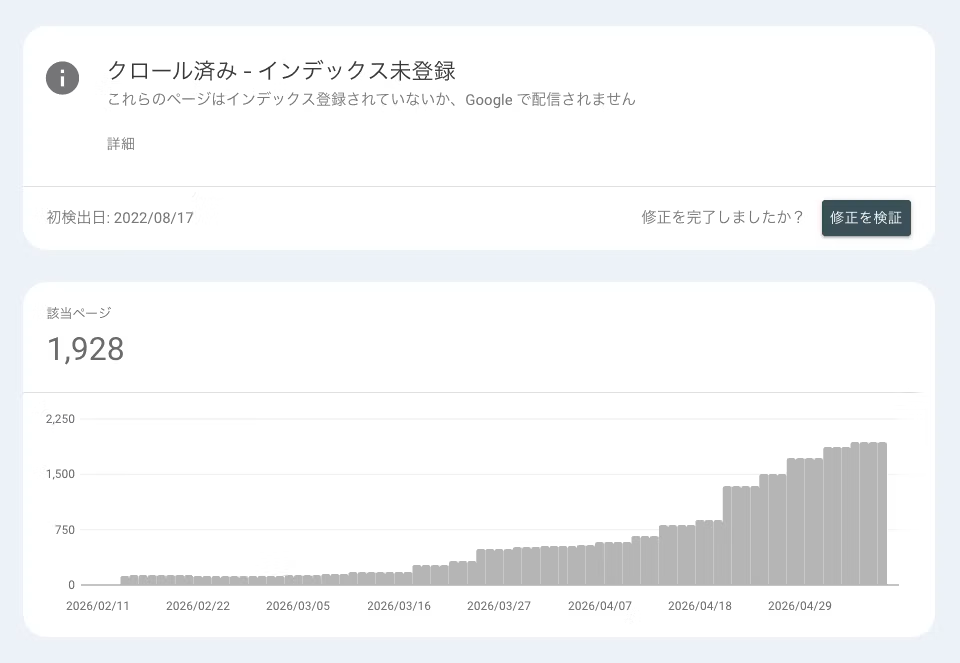
Published pages multiplied rapidly, with indexing reaching approximately 2,000 pages. Normally you would verify quality and search status one language at a time, but since this was our test site, we decided to try it all at once.
Note: The translation quality was quite rough and CSS emphasis caused text to be cut off, so we later migrated to Claude API. Since the translation method itself changed mid-experiment, this writeup isn't much of a formal report.
Migrating machine translation from Google Translate to Claude API
2. What caused the metrics to drop?
Shortly after launch, the DR (Domain Rating) that I'd been watching with the popular ahrefs tool dropped sharply. 😅
I didn't receive any manual action notifications in Search Console, but the suggestions that appeared when I searched for the company name on Google also decreased dramatically. (T_T)
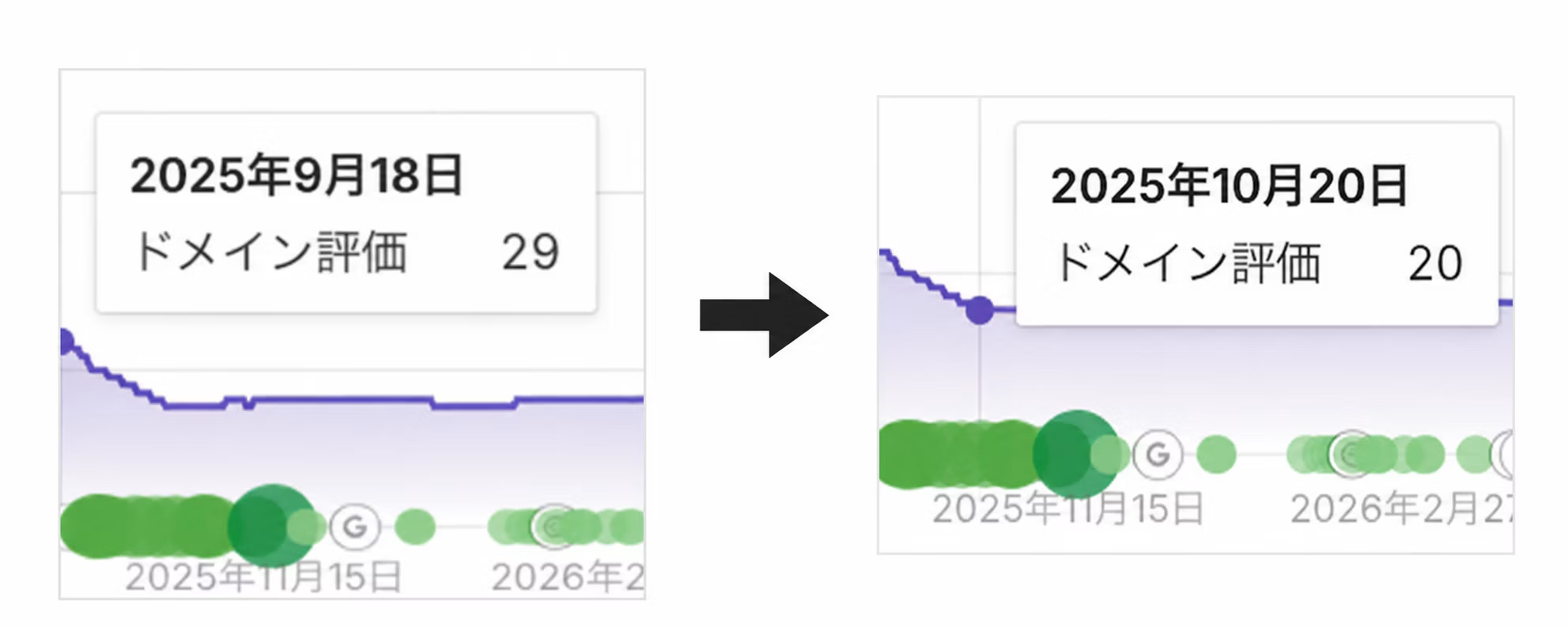
I don't know how Google made its judgment then or now.
DR is an ahrefs proprietary metric and doesn't directly indicate Google's evaluation or "penalty."
(Google used to publish it as an official metric called PageRank!)
I haven't been able to prove that the change in search suggestions was caused solely by adding translated pages.
I thought, "Maybe Google judged the bulk machine-translated pages as spam," and enjoyed feeling thoroughly defeated (T_T)
3. May 15, 2026: Reverting Course
After experimenting for about half a year, I realized my weird experiment might be dragging down Kazutsugi Futamata, our CAO who continues to shine in accessibility 😓, so I changed direction on May 15th.
I kept the English version and set the other translated versions to return X-Robots-Tag: noindex, nofollow using Cloudflare's _headers.
/fr/*
  X-Robots-Tag: noindex, nofollow
/zh-tw/*
  X-Robots-Tag: noindex, nofollow
I applied the same configuration to each of the target languages.
At the time, I expected that "adding a header would work immediately!" But of course, just adding something to the header doesn't make pages disappear from search results right away. Google needs to recrawl the relevant URL to recognize the noindex tag, and
you can submit a request, but the daily quota is extremely small (T_T)
After several months passed, the indexed page count in Search Console decreased to around 350 pages. I thought link equity distribution might have been reduced too, but I haven't fully grasped the actual impact.
Only Google knows the full story.
Reference: Google's explanation of noindex
4. Trying International Press Releases
For the English version, I kept indexing as is. To support the Chrome extension release, I also tried driving traffic from an overseas press release to the English homepage.
Liberogic Releases Two Chrome Extensions to Support Practical Web Accessibility Testing
Looking at Chrome's extension management dashboard, there are more overseas users, so I had hoped that promoting the English version would also have a positive impact on the entire site...
but in reality, it was only cited by a handful of sites, and I couldn't determine what SEO impact it had.
5. That said, DR has recovered somewhat
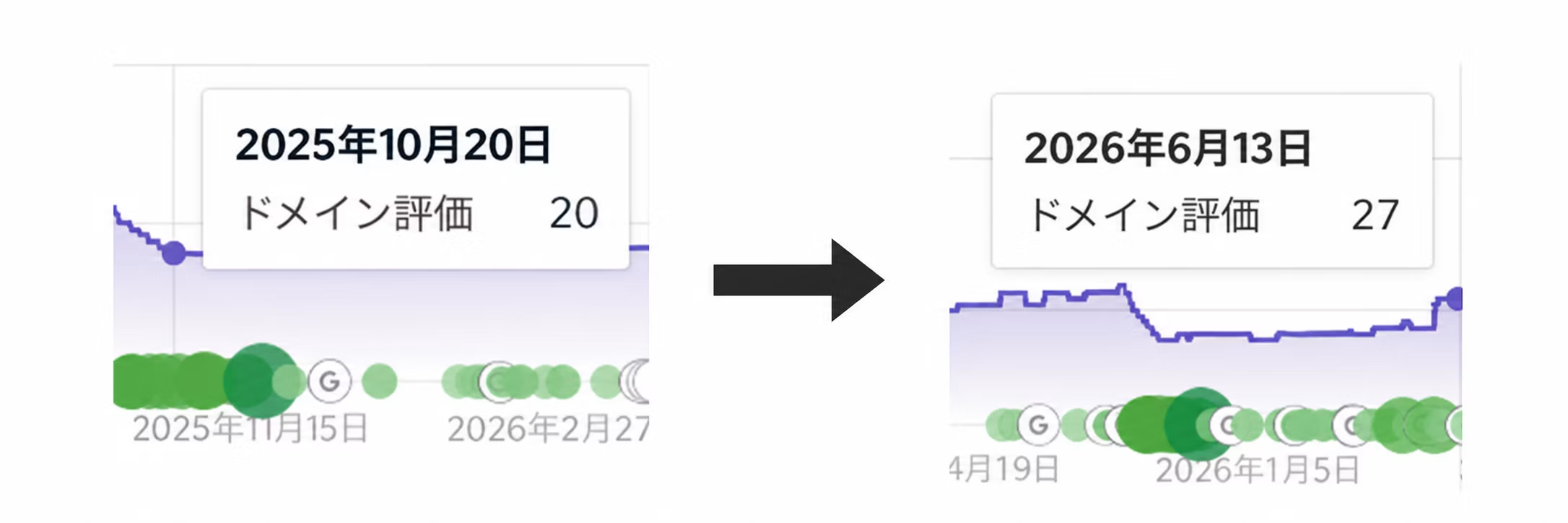
After trying various things, the DR somehow recovered. (Though it's still low!)
Since we receive a certain amount of inquiries from our website, we don't place too much emphasis on ahrefs' DR for our own site, but I'm relieved that it's not too low—it would be a bit embarrassing for our business. For a company of our size, I think the current DR is actually a sufficient level.
Translation quality is certainly one contributing factor, and there are many ambiguous elements, but it became clear that you can't simply say "as long as you ensure technical soundness and set canonical and hreflang tags correctly, you can go multilingual all at once."
When expanding multilingual content, it's best to publish one language at a time, verify translation quality and relevance to local readers, and record Search Console's indexing status, impressions, and search traffic before and after launch. Then move on to the next language.
6. Situation after that (as of September 2026)
After that, the search situation has settled down.
Currently, we're reindexing the Traditional Chinese page, which sees relatively high traffic, to see how things change. Now that we've restored another language after English, we're tracking how search traffic and "link juice" shift. While we can't see Google's internal evaluation directly, we're monitoring the search traffic visible in Search Console and the changes in ahrefs' DR.
If we focus only on non-Japanese languages, there's plenty we'd like to do.
We want to add Korean, which for some reason we didn't include initially, and we're curious about Sanskrit-like languages in India, languages using Cyrillic script, and right-to-left (RTL) languages from Arab countries.
We're unsure whether to keep or consolidate the various European languages we added on a whim back then (laughs).
By the way, since Google's spam update on September 24, the Google Search Console dashboard has been frozen from September 21 until now, which is very inconvenient!
It appears indexing is still happening, but it really drives home how important that chart is as a source of information.
There's one more topic related to backlinks, but we'll cover that in a future column.
I'll continue to update progress as it develops!




A CEO who always acts as a true counterpart. Someone who loves understanding new technologies, finds joy in those moments when something becomes more convenient, and is a hands-on person who dives deep into projects. Excited about the technologies of tomorrow, enjoying new experiences at every stage of life.
Tadanori Morimoto
Project Manager / Director / Founded in 2007