
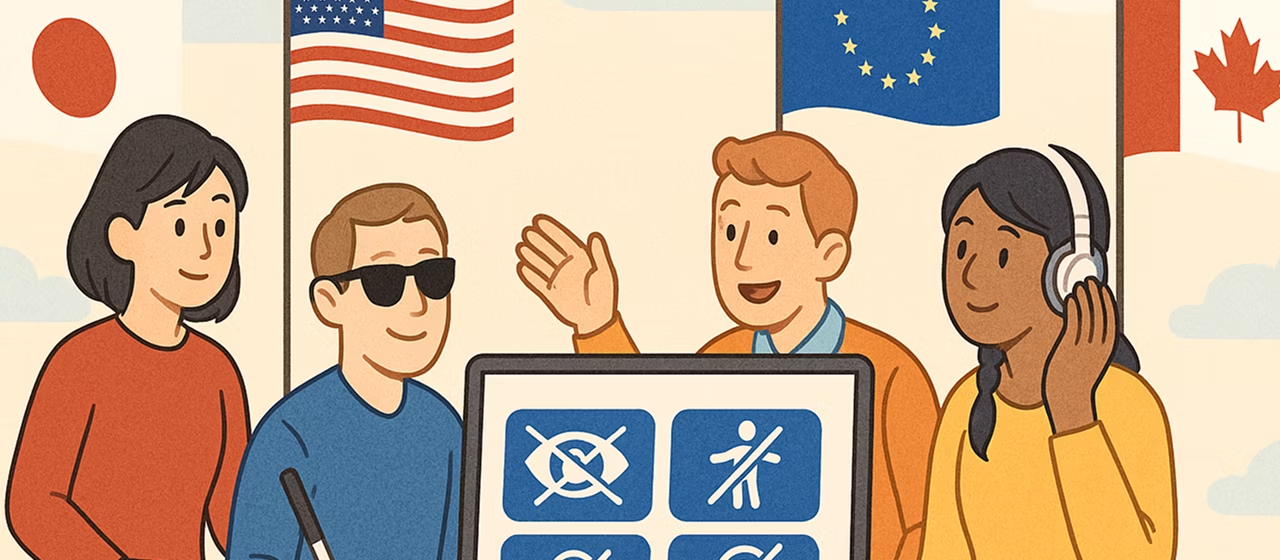
In Japan, web accessibility compliance is not yet strictly required. That said, awareness that it truly matters has grown considerably in recent years.
As you may know, Japan's Act for Eliminating Discrimination against Persons with Disabilities was amended in April 2024, requiring private businesses to provide "reasonable accommodation" for people with disabilities. While this law does not set specific standards or obligations, there is a growing expectation across society that accessibility is simply part of doing business, whether or not penalties apply.
Accessibility is no longer seen as anything out of the ordinary. It is spreading as a natural practice for delivering services to more people.
So how do attitudes and practices toward accessibility compare overseas?
Compared with major markets such as the United States, the EU, and Canada, the differences from Japan's situation become clearly visible.
Web Accessibility in Japan
In Japan, web accessibility compliance is mainly based on JIS X 8341-3:2016. This standard was developed with reference to WCAG 2.0, and future revisions of JIS are expected to move toward construction aligned with WCAG 2.2.
The Ministry of Internal Affairs and Communications offers a checking tool called miChecker to support conformance with this JIS standard (WCAG 2.0).
miChecker is an accessibility diagnostic tool that automatically checks the aspects that can be judged mechanically. As a result, it cannot cover many items, and human judgment is ultimately required; however, this part is often neglected.
Although "reasonable accommodation" under the Act for Eliminating Discrimination against Persons with Disabilities is a major legal framework, web accessibility lacks specific standards or mandatory compliance obligations, and there is no requirement to publish compliance status. This makes the difference from overseas countries with clear legal obligations and public disclosure systems (such as the United States and the EU) stand out.
In Japan, report formats are also optional. A Voluntary Product Accessibility Template (VPAT), commonly used in the United States, has inspired the Japanese Information Accessibility Self-Assessment Form (Japanese VPAT); however, it has not yet achieved widespread adoption.
Web Accessibility in the United States
In the United States, under Section 508 of the Rehabilitation Act, federal agencies are required to ensure accessibility when procuring information and communication technology (ICT).
The standard is based on WCAG 2.0 AA, and conformance with WCAG 2.1 AA is recommended.
In the private sector, the high litigation risk under the Americans with Disabilities Act (ADA) has led companies to actively pursue web accessibility.
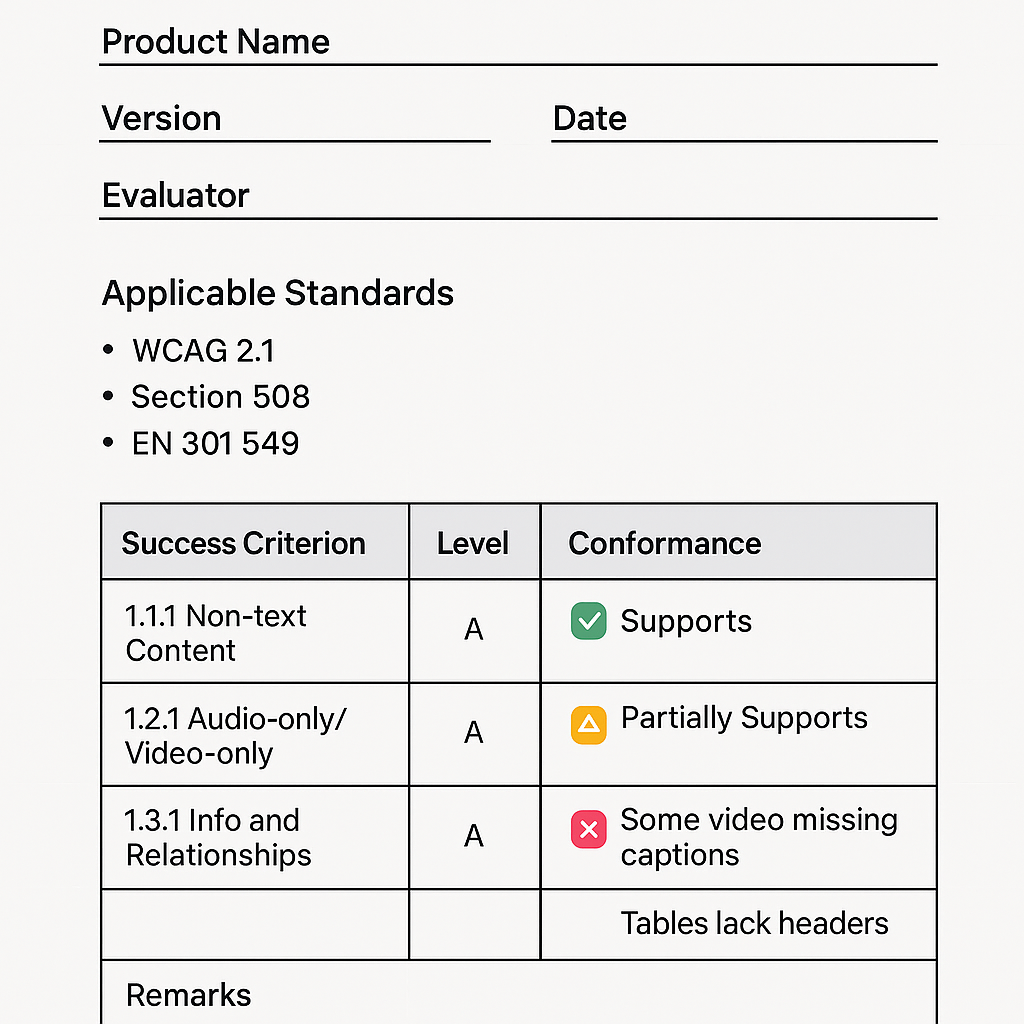
To avoid litigation risk, many companies create an Accessibility Conformance Report (ACR) using a Voluntary Product Accessibility Template (VPAT) to demonstrate their accessibility conformance status. In the VPAT, each success criterion is evaluated as Supports, Partially Supports, Does Not Support, Not Applicable, or Not Evaluated, with detailed reasons provided. These are then compiled into an ACR and published.
While automated testing tools such as axe-core and WAVE are utilized, the United States places strong emphasis on final judgment and detailed evaluation by humans.
This stands in contrast to Japan, where mechanical checks are central.
Web Accessibility in the EU
In the EU, the EU Web Accessibility Directive requires public sector websites and mobile apps to comply with the technical standard
EN 301 549, which is built around WCAG 2.1 AA conformance. A distinctive feature is the mandate to publish an Accessibility Statement.
This statement is similar to an expanded version of an accessibility policy as understood in Japan. It must describe in detail the site's accessibility status, any non-conforming areas, and alternative means of access. It also requires the provision of a feedback mechanism through which users can report problems.
While Japan's accessibility policies typically take the form of publishing test results, the key difference with the EU's Accessibility Statement is its emphasis on a system that lets users report issues directly.
From the items judged non-conforming to WCAG criteria, it selects the particularly important and high-impact non-conforming areas, and explains in clear terms the reasons for them along with the improvement plan going forward.
In addition, the European Accessibility Act (EAA) came into force in June 2025. This law imposes accessibility obligations not only on the public sector but also on certain private companies that do business in the EU market, covering the products and services they offer. It applies to areas such as e-commerce, banking services, e-books, and passenger transport services. Their websites and apps must also meet WCAG 2.1 AA, and they must prepare a document demonstrating EAA compliance called the EU Declaration of Conformity.
Web Accessibility in Canada
The federal law Accessible Canada Act (ACA, 2019), enacted in 2019, sets out the main framework for web accessibility. A major feature of this law, similar to the EU Web Accessibility Directive, is that it references EN 301 549 as its technical standard.
Under the ACA, government agencies and certain private companies (such as banks, telecommunications providers, and public transportation operators) are required to develop an organization-wide accessibility policy and regularly submit an Accessibility Compliance Report to the government on their progress.
Publishing this report to users is not mandatory, but in practice it is often released as an Accessibility Statement, summarizing the status of WCAG 2.1 AA achievement for the web components.
Separate from the federal law, some provinces have their own legislation, such as Ontario's Accessibility for Ontarians with Disabilities Act (AODA). Under provincial laws of this kind, the AODA requires public sector organizations and large private businesses to conform to WCAG 2.0 AA (with WCAG 2.1 AA recommended). It also requires accessibility compliance reports and, for large organizations, the development and publication of a multi-year accessibility plan.
In Ontario, there is a tendency to emphasize usability testing with people with disabilities in addition to automated testing tools. Educational institutions such as the University of Toronto provide practical guidelines for developers, aiming to improve accessibility based on more realistic user experiences.
Summary
Compared with leading countries in web accessibility, Japan's web accessibility efforts currently remain largely at the level of "best effort" or "voluntary" measures.
Meanwhile, given the amendment of the Act for Eliminating Discrimination against Persons with Disabilities and a growing awareness across society, there is a strong possibility that more concrete mandates and disclosure systems will be established in the future.
While treating it as a task is important, accessibility work is, above all, a natural effort to deliver services to more people.
Even if you start making gradual improvements now, you will be better prepared to adapt to future changes, and it can also help your site earn users' trust as a site they can use with confidence.
Not "because it's required" but "because we want to reach more people."
That kind of forward-looking approach to accessibility is likely to become even more important!ー
Liberogic Accessibility Audit Service
Liberogic offers an accessibility audit service.
What sets this service apart is its specialized audits aimed at compliance with international standards.
Rather than using miChecker, we conduct detailed audits based on our proprietary checklist covering WCAG 2.0 Level A through WCAG 2.2 Level AAA. Using tools such as axe-core, we also carefully verify the areas that require human judgment, from identifying issues to providing specific remediation guidance.
Our service also supports the VPAT format, and along with a certificate of inspection, we can provide an Accessibility Conformance Report (ACR).
Beyond audits, we are also happy to handle the creation and development of accessible websites while maintaining creative quality!
As a member of the International Association of Accessibility Professionals (IAAP), Liberogic supports the achievement of substantive accessibility that goes beyond mere formal compliance.


Starting out in DTP and moving into the web, he now handles markup, frontend, direction, and accessibility alike. A "master of all trades" who has been versatile since Liberogic's early days and is now a walking encyclopedia of the company. Lately he has been hooked on exploring efficiency through prompts, asking, "Can't we rely more on AI for accessibility work?" Both his skills and his thinking are still evolving.
Ayumu Futamata
IAAP Certified Web Accessibility Specialist (WAS) / Markup Engineer / Frontend Engineer / Web Director