
Liberogic is a member of IAAP (International Association of Accessibility Professionals), and our team includes holders of WAS (Web Accessibility Specialist), an advanced professional credential. Building on our expertise in internationally recognized knowledge and techniques, we conduct regular staff training as leaders in delivering high-quality web accessibility services.
As part of this initiative, we participated in "Dialogue in Silence: A Conversation in Quietness," an experience that simulates the world of people with hearing disabilities. This visit to the Dialogue Diversity Museum marks our second such training, following our earlier experience at "Dialogue in the Dark," which simulates the world of people with visual disabilities.
Read about our Dialogue in the Dark training experience
■About Dialogue in Silence
Dialogue in Silence is entertainment where participants enjoy meaningful dialogue transcending language barriers in a world without sound.
The experience is guided by deaf attendants—experts in dialogue without relying on voice. Participants wear noise-blocking headsets. In the silence, they heighten their focus, observation, and expression, experiencing a liberating sense of freedom.
Through body language and silent communication, participants discover ways to connect without sound or speech. Even between people from different countries, the depth of interaction often exceeds expectations.
Since its launch in Germany in 1998, the event has been held in France, Israel, Mexico, Turkey, China, and many other countries. More than 1 million people have experienced it worldwide, and in Japan, since its first event in 2017, approximately 24,000 people have participated.
Quoted from the Dialog in Silence official website https://dis.dialogue.or.jp/
After check-in, participants are instructed that speaking is prohibited in the experience area, and nothing can be brought inside—not even bags, phones, watches, or accessories.
To create a thoroughly silent environment, the experience begins with participants having let go of all their belongings. The other members in my group had no idea what was about to happen, and everyone looked slightly nervous. I likely had a similar expression.
Guided by a deaf attendant, we put on headsets that block sound and moved through several rooms. Each room had a theme, and without speaking, we communicated using designated means—hand signs, gestures, facial expressions, and basic sign language—to complete the assigned tasks.
Inside each room, aside from a single-line theme statement on a placard, there's virtually no information despite mysterious props scattered about. Observing the attendant carefully and deducing what task they're about to present and how to solve it requires genuine skill.
My initial thought of "This might be easier than expected" was short-lived. Accustomed to communicating through voice and text, when it came time to actually convey something, I found myself wondering "How do I say this?" There were moments of real struggle, and I used far more mental effort than anticipated.
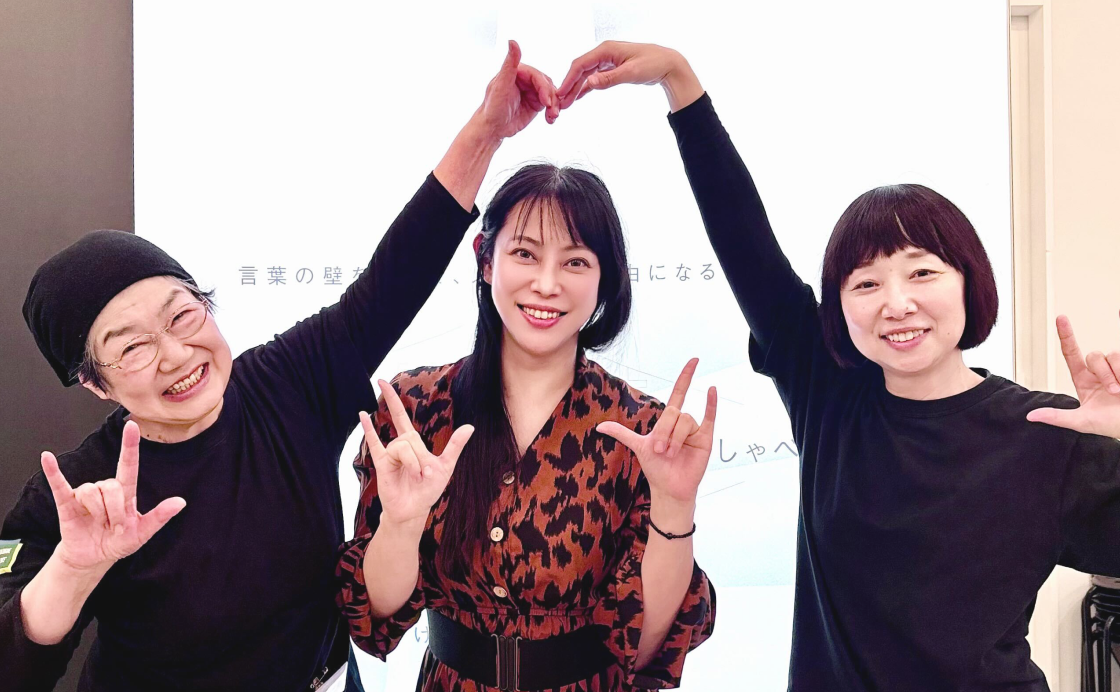
At the end of the experience, we removed the headsets and communication through spoken words was allowed again. Sharing our impressions as a group through both conversation and written notes, when asked "What was the silent world like?" I instinctively answered, "Lively."
Without sound, everyone was eager to express their thoughts, so facial expressions became more vivid than usual, and gestures naturally grew bigger and more expansive.
In spite of the silence, it was a time filled with palpable energy.
"If there is a desire to communicate and a willingness to understand, the essential message comes through." That feeling resembles the experience of desperately using body language to communicate in a foreign country where words don't work.
On the other hand, with older adults and elementary school children who participated in the same session, body language alone didn't work well due to age-related differences in perception, and there were moments of frustration. Reflecting on all of this, it was a deeply thought-provoking experience with much to learn.
Recognizing that people have diverse backgrounds—disabilities, languages, ages, and more—we must build a society that leaves no one behind. To that end, Liberogic will continue to learn about accessibility and apply that knowledge to our actual projects and implementation going forward.
*Note: This article uses the term "person with a disability" because when "障がい者" is used, screen readers used by people with visual impairments may mispronounce it. Thank you for your understanding.


Started her career as a professional writer at age 15. What was supposed to be a dual career in entertainment and writing has somehow evolved into being known as someone who is unusually passionate about saunas and cats. Holds certifications as a Level 1 Psychological Counselor and Senior Psychological Counselor.
Ai
Creative Director / Screenwriter / Managing Executive Officer, Godo Kaisha Nekoana / ENTJ, Cool undertone, Straight body type