
Creating Web Experiences That Feel Comfortable for Everyone
The internet is an important space where everyone can conveniently access information and connect with others. However, due to subtle differences in design and functionality, some people can use it smoothly, while others cannot.
Since April 2024, the Act for Eliminating Discrimination against Persons with Disabilities has made it mandatory for businesses and public institutions to provide reasonable accommodation, making web accessibility compliance more important than ever.
Liberogic is committed to web accessibility with the goal of creating "web experiences that are easy to use for everyone." We carefully address structure, design, and coding in line with the international WCAG standard, JIS X 8341-3:2016, and the latest guidelines from the Digital Agency and the Ministry of Internal Affairs and Communications of Japan.
Our corporate website complies with the WCAG 2.2 AA accessibility standard and has also been featured in Torque's Accessible Website Gallery!
As developers, we may understand implementation technologies, but we can only imagine what people with disabilities think, what they struggle with, and why they face difficulties.
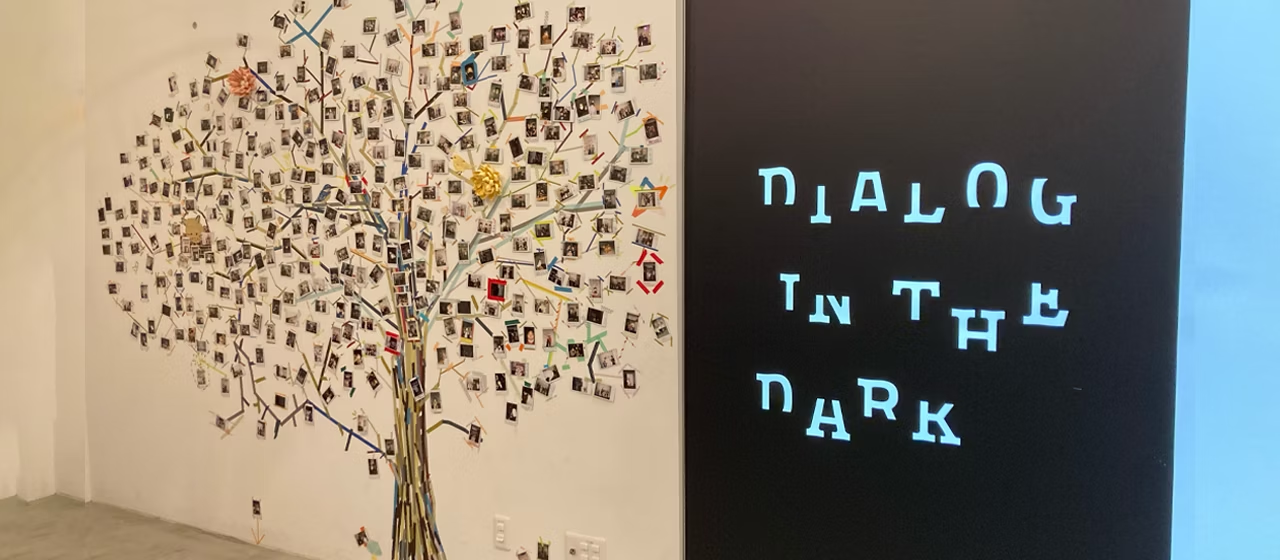
As accessibility professionals, we wanted to deepen our understanding. As part of our training, our entire team participated in "Dialogue in the Dark," an experience that simulates the world as seen by people with visual impairments.
Dialogue in the Dark
Have you ever seen anything with something other than your eyes?
Dialog in the Dark is a social entertainment experience in which guests, guided by visually impaired guides, explore the senses beyond sight and engage in communication in a "100% pure darkness" where all light is completely blocked.
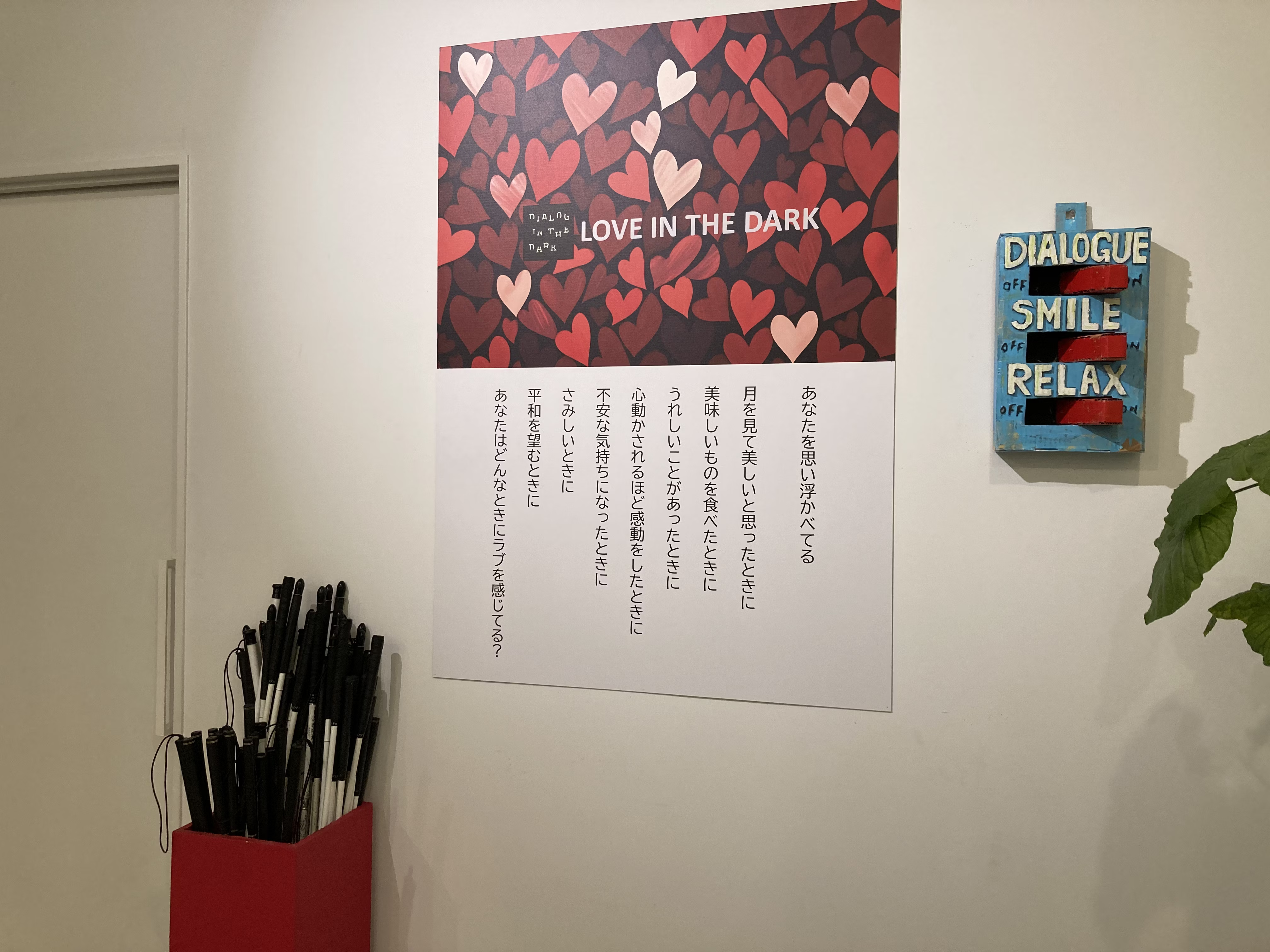
The experience begins with choosing a "white cane" (hakujo), the same cane carried by visually impaired people. Using the cane as a guide, participants move through a pitch-black room and take on a variety of challenges by relying on senses other than sight.
Without sight, it was impossible to gauge the distance to others or the size of the space, so I didn't know where I was. I felt a real fear of bumping into something. It made me realize how much we rely on our eyes in everyday life.
Because sight was blocked, voices were our only means of communication. What left the strongest impression was how everyone naturally started calling out to one another, saying things like "There's a ●● here" or "Careful, it's dangerous!"
The team was surprised by one new discovery after another in this first-time experience, and they gained many insights and lessons. Here are a few of them.
Mr. M:
I have severe nearsightedness, so everything is blurry. I can't make out shapes or letters well, but I can fill in the gaps using colors. Experiencing a world with zero vision made me realize how different it is from having some sight at all.
Ms. H:
I thought the white cane was only for detecting tactile paving and understanding space, but I was amazed to learn that by tapping the ground and feeling how the cane slides, you can even perceive textures. I realized that touch provides a lot of information, not just hearing.
Mr. O:
When I try to recall what was in the room, I find myself with vague memories as if I had actually seen them, even though I couldn't. I suppose that's because I stored the information as if it had come from sight.
Through Dialog in the Dark, I discovered the senses that become sharper precisely because we cannot see, and I came to appreciate the importance of communication.
There is much more I'd love to share, but since spoilers are not allowed, I'll have to hold back. Please experience it for yourself!
Until now, I had a vague sense that accessibility was gaining importance and was therefore becoming something web production teams were starting to incorporate. Through this experience, however, I truly came to understand the importance and necessity of web accessibility services. I intend to draw on this experience and strive to provide web experiences that are easy for all users to use!
Note: In this article, we use the term "障害者" (persons with disabilities). We avoid the alternative spelling "障がい者" because some screen readers, which visually impaired users rely on, may read it aloud as "sawarigaisha". Thank you for your understanding.


I work mainly on markup and frontend development using JavaScript, React, and Next.js. I'm always happy when a site I've been involved in launches successfully! My hobbies are playing the guitar. I love cats and roasted sweet potatoes 🐱🍠
Hirocchi
Frontend Engineer / Joined in 2022