

Following my previous project, where I built a diff app for a VS Code extension with Claude Code, I decided to create a purely personal app: a [Cat Diary].
I used Claude Code for the implementation itself, but along the way I used Groq (pronounced "Groq"), which made headlines a little while back, so I'd like to introduce it here.
How I Came to Use the Groq API
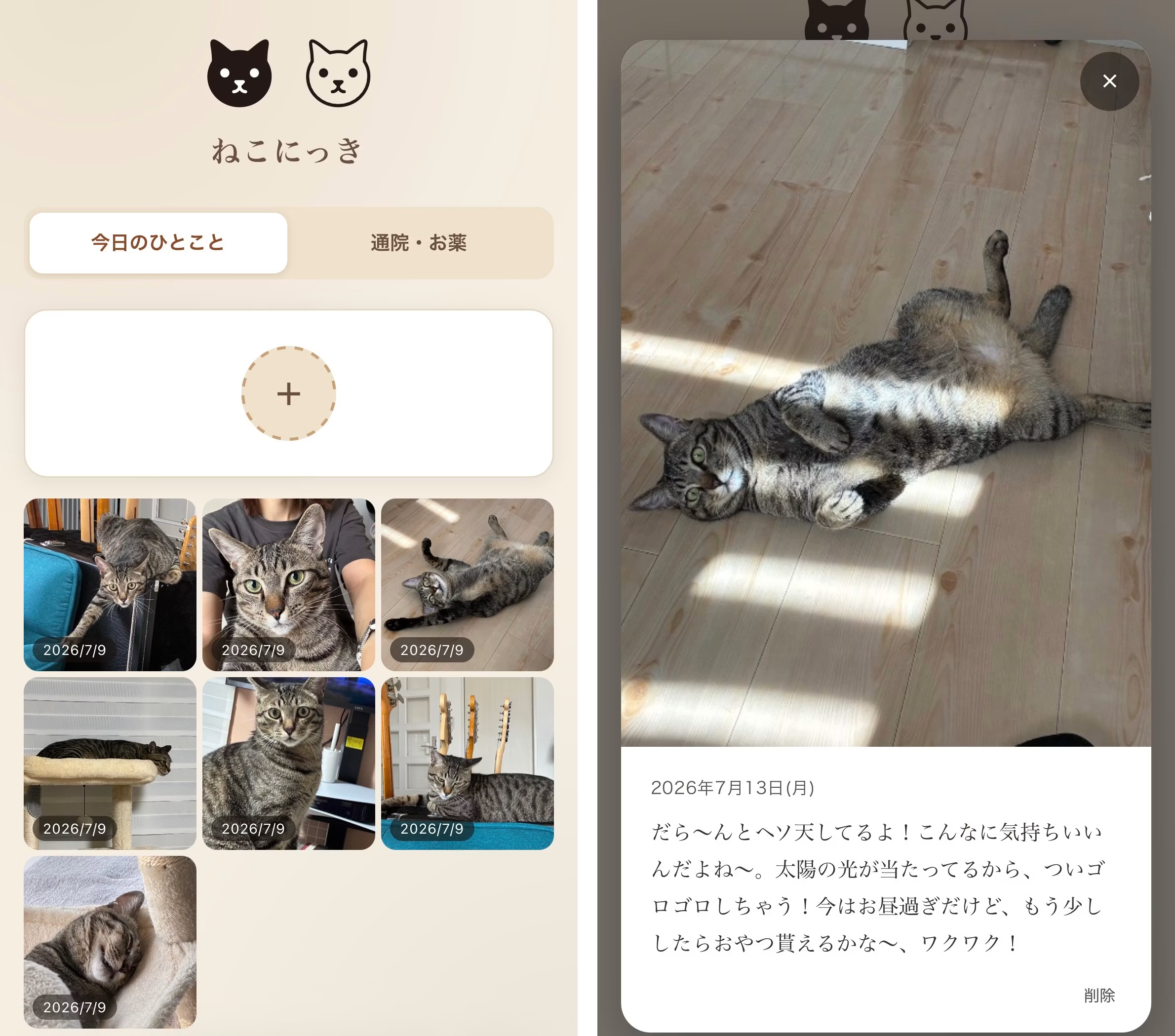
App Overview
Simply uploading cat photos and organizing them into a favorites folder seemed a bit dull, so I thought it would be fun if an AI looked at the uploaded photo and generated a comment from the cat's point of view. I quickly put it together.
Users enter the cat's profile, personality, and favorite things in advance. Based on that, the prompt instructs the model to always write in the cat's first-person voice, expressing its feelings and actions directly.
When a photo is uploaded, the app generates a comment of roughly 100 to 160 characters in 2 to 3 sentences, written from that cat's perspective.
Free LLM API: Groq
Generating comments requires an AI API.
The suggested option was Groq, an API service that supports images and offers a free tier, along with Scout from the Llama 4 model series.
Official website: Groq
Groq does not build its own "AI models" like ChatGPT or Gemini. Instead, it offers a service that runs open AI models developed by other companies, such as Llama, which Meta releases for free, on its own high-speed chips.
Its basic usage tier is completely free and requires no credit card registration. I was able to sign up, generate an API key, and integrate it directly into an app.
(The service is currently free, but usage terms may change in the future, so please keep this in mind.)
Groq itself was founded in 2016, but it only started attracting attention for its business of running AI inference at extremely high speed with dedicated chips around 2023 to 2024, making this a relatively recent trend.
I tried Groq!
According to its claims, it can process more than 100 tokens per second, and it generates responses about 20 times faster than ChatGPT.
I asked Groq Chat, "Explain cats as creatures in 1,000 characters."
Show video transcript (Japanese)
(Groq chatに「猫という生き物について1000字で解説して」と入力)
(質問を受け取ってから即時回答が生成される)
From receiving the question to completing the response took 1.91 seconds!
Super fast!!
Not only is it blazing fast, it also succeeds in significantly reducing power consumption compared to conventional GPUs.
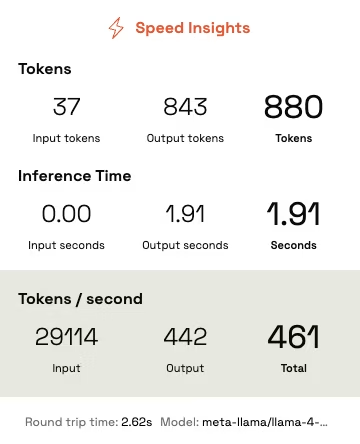
In our test, it generated a response of 843 tokens (equivalent to several hundred Japanese characters) in just 1.91 seconds (442 tokens per second).
Leveraging a High-Speed API
Best suited for
- Apps where response speed is critical — Groq's greatest strength is its generation speed, powered by its dedicated LPU chip, making it well suited for chatbots and real-time UIs where responsiveness matters, such as ones that reply instantly as the user types or voice assistants that depend on a natural conversational rhythm.
- Processing large volumes of simple tasks — Use cases such as summarization, classification, and simple text generation, where you want to process large numbers of requests while keeping the cost per item low.
- Prototypes, personal projects, and internal tools — Ideal when you want to get an idea running quickly and test it for free, as with the app in this project.
Less suitable scenarios
- Production services that depend on nuanced Japanese expression or complex instructions — In our first prompt, first-person instructions were not reflected well, and Claude and ChatGPT remain more consistent in reproducing detailed instructions. That said, Japanese support has improved considerably.
- Commercial services requiring stable operation — The free tier has rate limits, and models are retired or changed relatively often (in fact,
llama-3.2-11b-vision-previewwas discontinued partway through), so it is not well suited to core production features.
Summary
Groq is a service with a clear strength: blazing-fast generation speed.
Because it is a "free AI API," the ease of integrating it into an app on the same day you think of an idea is a big boost for personal projects and projects in the validation stage, and the hesitation of "Paying for it feels a bit much..." disappears.
Combining Groq's strengths with Claude Code's ability to "handle the implementation" means that
"prototyping an idea the moment you have it and polishing it all the way to a responsive experience"
—app development with this kind of speed—is entirely achievable even for an individual developer!!



I work mainly on markup and frontend development using JavaScript, React, and Next.js. I'm always happy when a site I've been involved in launches successfully! My hobbies are playing the guitar. I love cats and roasted sweet potatoes 🐱🍠
Hirocchi
Frontend Engineer / Joined in 2022