

"System development" used to mean writing large requirements documents, dividing work into phases with assigned owners, going through multiple review cycles, and taking months or even years to complete.
That approach has not disappeared entirely, but the practice of application development has already shifted to a model built around AI agents.]
AI agents are not just tools that autocomplete the code you point them to.
They read the entire repository, plan the work, edit multiple files, run tests, revise based on the results, and package the changes for review.
This whole sequence of tasks now operates as one continuous flow.
This is not a story about the future. AI agents running part of the development process is already a practical option in the field.
AI agents have moved from "assistance" to driving the development process
The stages of "requirements definition → design → implementation → testing" have not disappeared. What has changed is that each stage is no longer passed through just once, in sequence.
Give an AI agent the purpose and acceptance criteria, and it assembles an implementation plan and produces code and tests. If the running result feels off, people revisit the requirements or UI, and the agent again carries out implementation and verification. Development that cycles between requirements, design, implementation, and verification in short loops is already a reality.
People spend less time writing code line by line, but that does not make software development unnecessary.
What is required of people is deciding how much to hand over to AI agents, clarifying the purpose, constraints, and acceptance criteria, and judging whether the results are sound.
From "building after the meeting" to "building and verifying on the spot"
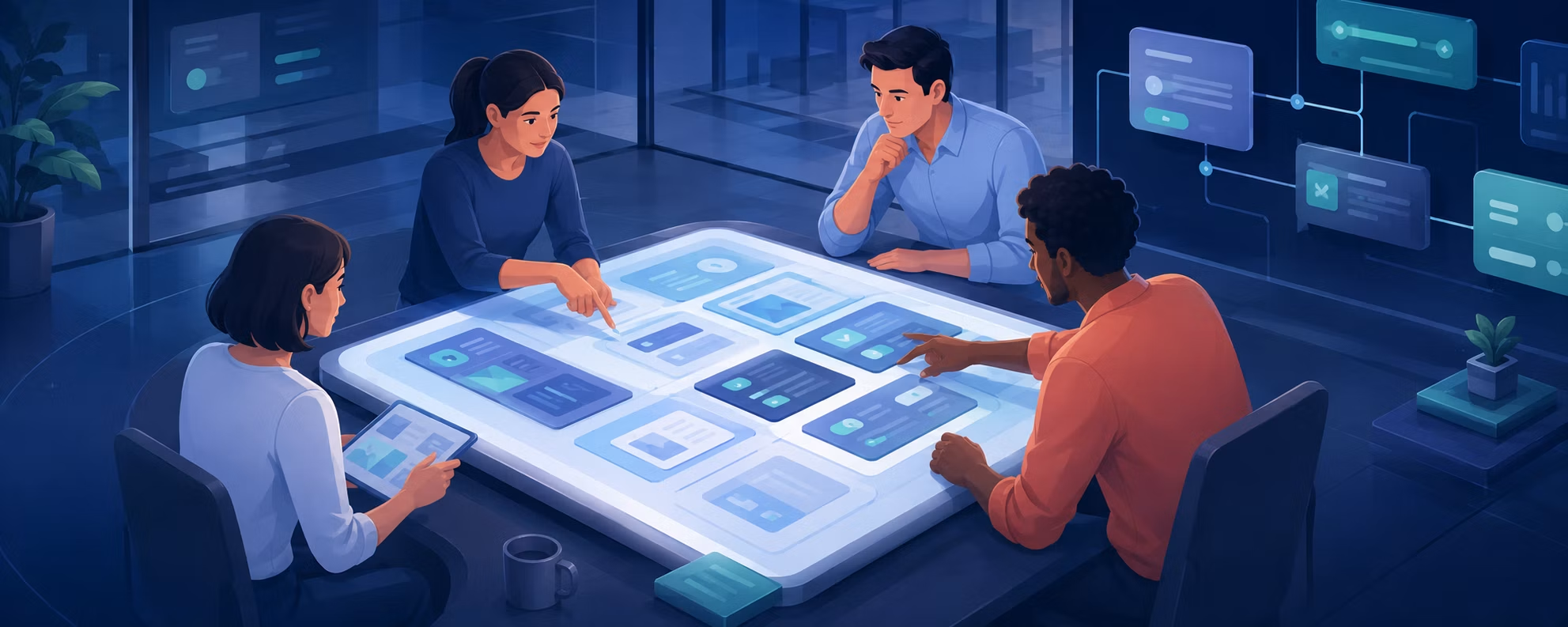
We generate UI while listening to client requirements, align it with the existing design system, and consider how it should connect with APIs. Based on feedback, we change screens and behavior on the spot. Work that used to belong to the prototype stage can now be carried out with a precision close to production implementation.
However, a screen that works and an application that can be safely used in production are not the same thing.
Only when data design, access control, exception handling, performance, monitoring, operations, and maintenance are all in place does it become an application that can be used for real business.
AI agents have greatly accelerated getting to a working form, but the design and judgment needed to keep it safe and reliable over time remain just as essential.
Driving more with AI agents and a small team
AI agents can carry out implementation, testing, documentation, and research in sequence, so the scope a small team can handle has grown considerably.
As a result, the boundaries between designers, frontend engineers, backend engineers, and testers have moved closer together. Rather than roles disappearing, the shift is toward fewer handoffs between disciplines and one team owning everything from decisions through improvement.
Rather than connecting many people through long chains of work, a small team that shares context moves quickly, while specialists review key points. This development structure has become a realistic option.
Security matters more than ever as we build faster
AI agents do more than suggest code. They can modify files, call external tools, and run tests and builds. As the range of actions they can take expands, they may also move quickly toward incorrect implementations or risky changes.
AI agent-driven development introduces new risks on top of traditional vulnerabilities, including suggestions of nonexistent or outdated dependency packages, oversights in authentication and authorization, leaked secrets, excessive permissions, prompt injection, and unintended changes to CI/CD configurations.
For this reason, code generated or modified by AI agents requires clear quality gates that are at least as rigorous as those applied to code written by humans.
- Limit the permissions and connections granted to AI agents to the minimum necessary.
- Run in environments isolated from production secrets.
- Automatically inspect dependencies, vulnerabilities, and licenses.
- Have humans review authentication and authorization, input validation, and the handling of personal information.
- Do not consider code safe solely because tests pass.
- Record who reviewed and approved each change.
Code is not safe simply because an AI agent wrote it, nor is it dangerous simply because an AI agent wrote it. What matters is designating a person who holds final responsibility and using AI agents within a secure development process that includes permissions, execution environments, inspection, and approval.
Accessibility cannot be achieved by AI agents alone.
AI agents can also make a real impact in the field of accessibility.
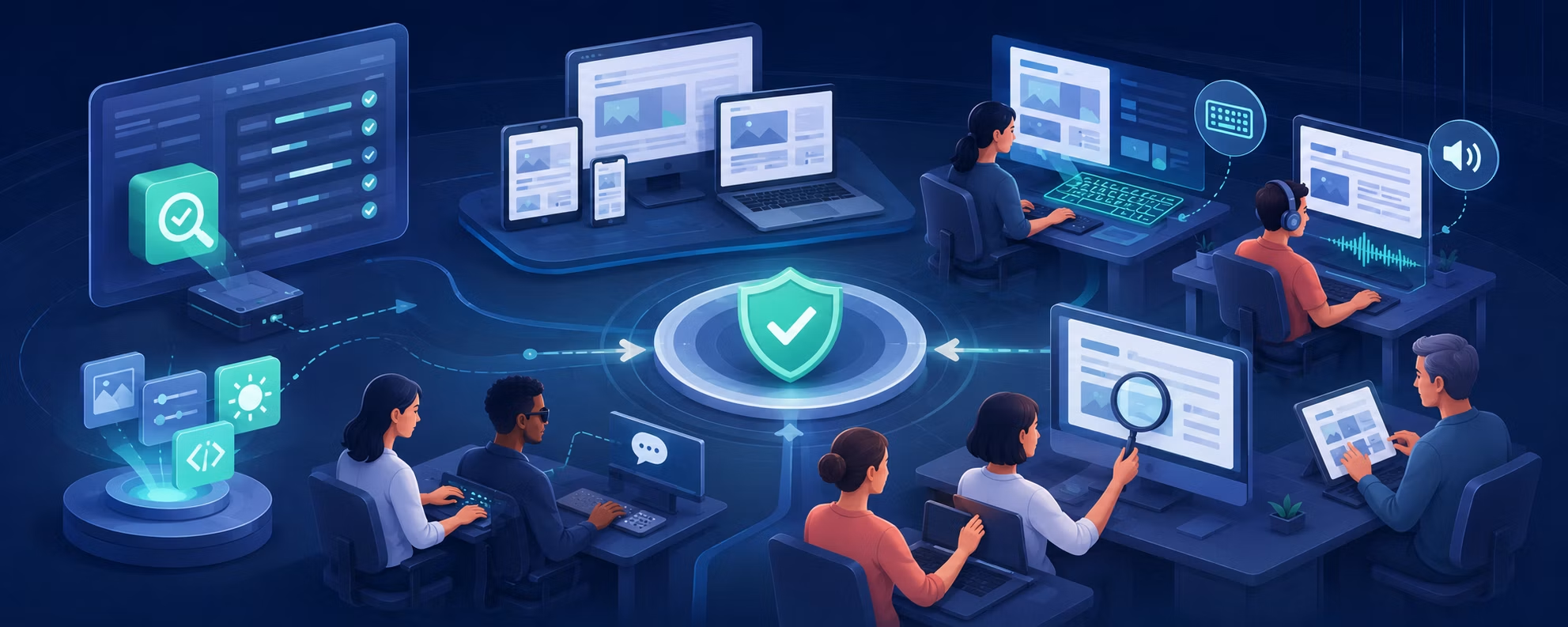
The range of tasks that can be automated keeps growing, from analyzing HTML structure, detecting missing labels, and drafting alternative text suggestions, to checking color contrast, generating test cases, and implementing proposed fixes. They also help surface issues early in design and implementation, which lowers the cost of fixing them.
However, most accessibility issues cannot be fully judged by automation. The W3C's evaluation methodologies likewise emphasize using evaluation tools alongside review by experts and, where appropriate, the participation of people with disabilities.
The following points still require visual inspection and hands-on testing.
- Can users operate everything with the keyboard alone without getting lost?
- Is the focus order and focus indication natural?
- Are state changes and errors conveyed properly by screen readers?
- Is no information or functionality lost when content is zoomed or reflows?
- Do headings, link text, and alternative text make sense in context?
- Can real users complete their intended tasks?
In short, automated inspection and correction by AI agents, combined with visual checks, manual operation, and verification with assistive technologies by people, go hand in hand. Rather than treating accessibility as a final checklist item, it has become increasingly important to build it into every stage: requirements, design, implementation, and testing.
What is needed is an engineer who can provide context and constraints
Going forward, engineers will be valued not simply for writing code quickly or for writing good prompts.
They are the people who clarify why something is being built, who will use it, what defines it as complete, and which risks are unacceptable. They give AI agents the right context and constraints, design permissions and quality gates, and verify the results.
The engineer's role is shifting from carrying out every task alone to appropriately combining AI agents and specialists to guide quality. And the ultimate responsibility for correctness, safety, and usability still rests with people.
As Liberogic
At Liberogic, adopting AI is not our primary goal in itself.
We turn the expertise we have built in modern frontend development, complex API integration, UI/UX design, and accessibility services into the context and constraints we give AI agents, speeding up verification and improvement.
Build it quickly. Test it hands-on. Then refine it, including security, accessibility, and maintainability, until it is ready to use with confidence.
Rather than choosing between speed and quality, we direct that effort toward deeper verification and a better experience. That is our view of how development should work going forward.
Finally
Application development has already changed.
From a process where people carry every task themselves,
to one where people define the goals and constraints, AI agents execute the work, and people verify the results and take responsibility.
The question going forward is not whether you use AI agents.
It is how much you delegate, what permissions you grant, where people make the decisions, and how you bring the output to a level of quality you can trust.



Though I'm the president, I'm always a hands-on counterpart. I take joy in understanding new technologies and in those moments when something becomes more convenient, and I love being completely absorbed in the work on the ground. I get excited about future technologies and want to keep enjoying new experiences no matter how old I get.
Tadanori Morimoto
Project Manager / Director / Founded 2007